QCD and Cosmology
Exploring the strong interaction as a key to dark energy and dark matter
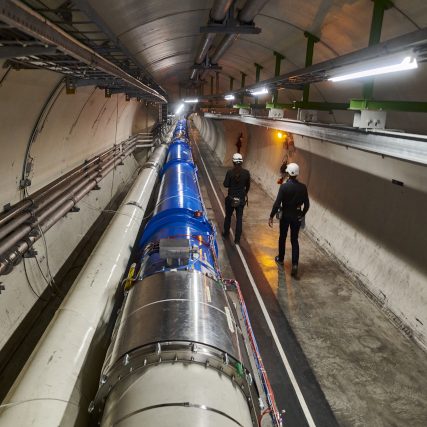
Samuel Joseph Hertzog / CERN
Quantum chromodynamics (QCD), the theory of the strong interaction, is a cornerstone of particle physics, supported by decades of experimental tests, from the structure of protons and neutrons to high-energy particle collisions.
Our team explores how QCD could shed light on the origin of dark energy and the nature of dark matter, by pursuing new avenues of research beyond the search for the QCD axion.
Our work brings together theoretical physicists and observational cosmologists, placing equal emphasis on theoretical foundations and tests against astronomical observations.
Can dark energy emerge from the Standar Model of particle physics?
Could the topological structure of the QCD vacuum give rise to sensitivity on cosmological scales and account for dark energy?
The QCD axion is a prominent dark matter candidate and the focus of an active search programme. What if early-Universe axion dynamics also produced a formation relic: dense, macroscopic aggregates of antiquark matter, called AQNs?
Could these quark aggregates emit a faint “dark glow” within reach of Euclid and JWST, offering an observational test of their macroscopic nature ?
Many experiments are engaged in an intense quest to detect the QCD axion, a search that lies outside our team’s work but is closely connected to our research on QCD and cosmology.
Explaining this research means crossing boundaries between cosmology, general relativity, particle physics, quantum mechanics, thermodynamics, and plasma physics. We aim to explain the key ideas accessibly, while preserving their scientific substance.
News feed
Current Projects and Latest Results
A numerical QCD-AQN was born
A comprehensive model of AQNs is under development, enabling detailed calculations of their interactions with both dilute and dense cosmic environments and reducing reliance on simplifying approximations. Previous comparisons with observations have been reassessed within this framework, with no major discrepancies identified.
Dark glow in Cloud-9
Cloud-9 offers a particularly clean target for searching for the predicted AQN dark glow, since the absence of stars greatly reduces competing sources of emission. Our first step is to calculate if this emission can be detected by the JWST.
QCD-DE: Improving the switch fonction
We are exploring whether a physically motivated relation between the onset and duration of the transition could reduce the activation function to a single free parameter, and therefore increase the bayesian factor of the QCD-DE model.
Conferences and Media Updates
Colloquia
QCD-DE
UCL, Oct 21, 2026
Imperial College of London, Oct 27, 2026
Univ. of Borhum, Oct , 2026
Seminars
QCD-DE
Univ. of Newcastle, Oct 30, 2026
Univ. of Durham, Nov 5, 2026
APC, Nov 12, 2026
In the media
TBA
The next frontiers
A list of observational tests for the near future
QCD and dark energy
Testing QCD-DE with upcoming DESI observations
Future DESI results will measure the Universe’s expansion history more precisely, allowing us to test whether its evolution follows our QCD-DE scenario. Combined with SN X and CMB observations, these measurements could strengthen support for the model or rule out its predicted expansion history.
QCD and dark matter
Testing QCD-DM with the 21 cm emission
The interaction between antimatter AQNs and baryons provides several mechanisms by which the 21-cm signal could be modified. In particular, the injection of low-energy photons would contribute to the
radio background in addition to the CMB, while higher-energy UV and X-ray photons could alter the thermal and ionisation history of the intergalactic medium. In this context, precision 21-cm cosmology constitutes a decisive empirical test of the AQN scenario. Our recent AQN numerical model will allow us to make predictions about this signal.
Detecting the dark glow with Euclid, JWST and SPT
TBA
Testing QCD-DM with the next generation of radiotelescopes
Next-generation radio telescopes, combined with absolute sky-brightness measurements, could determine whether the ARCADE 2 excess persists after improved subtraction of astrophysical sources and whether its intensity and spectrum match the emission predicted by the AQN framework.
Testing QCD-DM with the 511 keV emission
An observational test of the QCD-AQN framework would compare a predicted Galactic 511 keV intensity map with observations using realistic dark matter and baryon distributions. The key challenge is reproducing the bulge’s spatial extent, symmetry, and surface-brightness profile while testing the predicted correlation with baryonic matter and low positron energies.