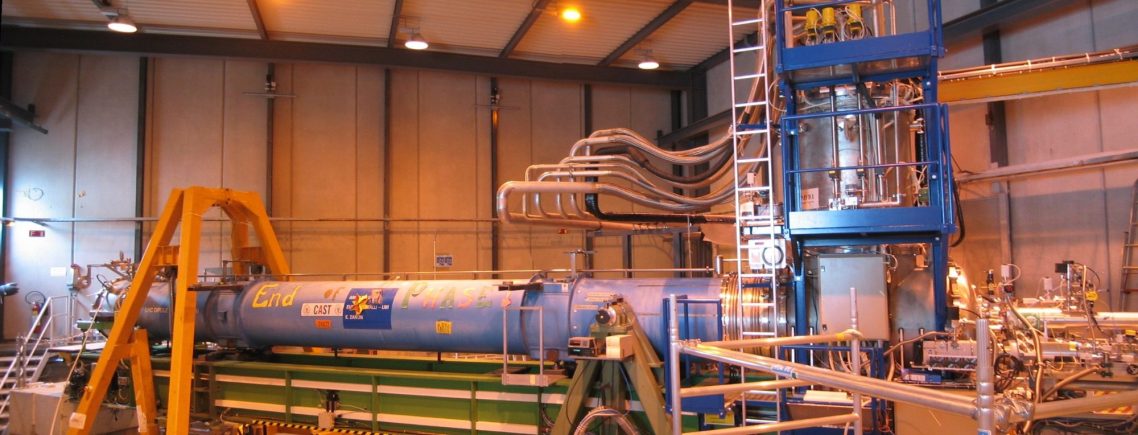
CAST experiment at CERN. Photo: Roland Hagemann.
The search for
the QCD-axion
The QCD axion is a hypothetical particle proposed to explain why the strong interaction shows no measurable violation of CP symmetry. It could also account for the Universe’s dark matter. These two motivations have inspired an intensive international search, bringing together particle physics, astronomy and quantum sensing.
The challenge is that axions would interact extremely weakly, and their mass remains unknown. Experiments must explore different mass ranges and interaction strengths. No confirmed detection has yet emerged.
One major approach uses haloscopes, which search for axions in the dark matter surrounding our Galaxy. Experiments such as ADMX, HAYSTAC and CAPP place microwave resonators inside powerful magnetic fields, looking for the faint electromagnetic signal produced when axions convert into photons.
Other designs extend this strategy into different mass ranges. MADMAX is developing a dielectric haloscope using carefully arranged disks, while DMRadio uses electrical circuits to seek signals from lighter axions. CASPEr searches for tiny effects of the axion field on nuclear spins.
Helioscopes instead look towards the Sun, where axions could be produced in the hot interior. Following CAST, the BabyIAXO and IAXO programme aims to convert solar axions into detectable X-rays using magnets, specialised optics and detectors with exceptionally low backgrounds.
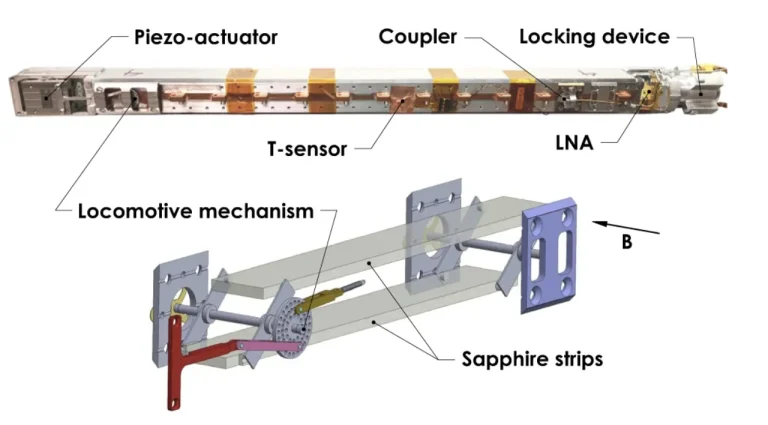
CAST-CAPP cavity assembly and tuning mechanism. C. M. Adair et al., “Search for Dark Matter Axions with CAST-CAPP,” Nature Communications 13, 6180 (2022), Fig. 1.
Although these experimental searches lie outside our team’s work, their results matter directly to the AQN framework: the QCD axion is central to the proposed formation and stability of AQNs.
In the QCD-AQN framework, quark aggregates arise as a by-product of QCD axion production and hadronic phenomenology, opening the possibility of a heavier axion than in scenarios where axions alone account for all of the Universe’s dark matter.