The QCD dark energy framework
QCD dark energy (QCD-DE) proposes that the non-trivial topology of the quantum chromodynamics vacuum could explain the origin, small amplitude, and late-time evolution of dark energy without introducing new particles. Our team works on theoretical foundations, cosmological predictions and observational tests.
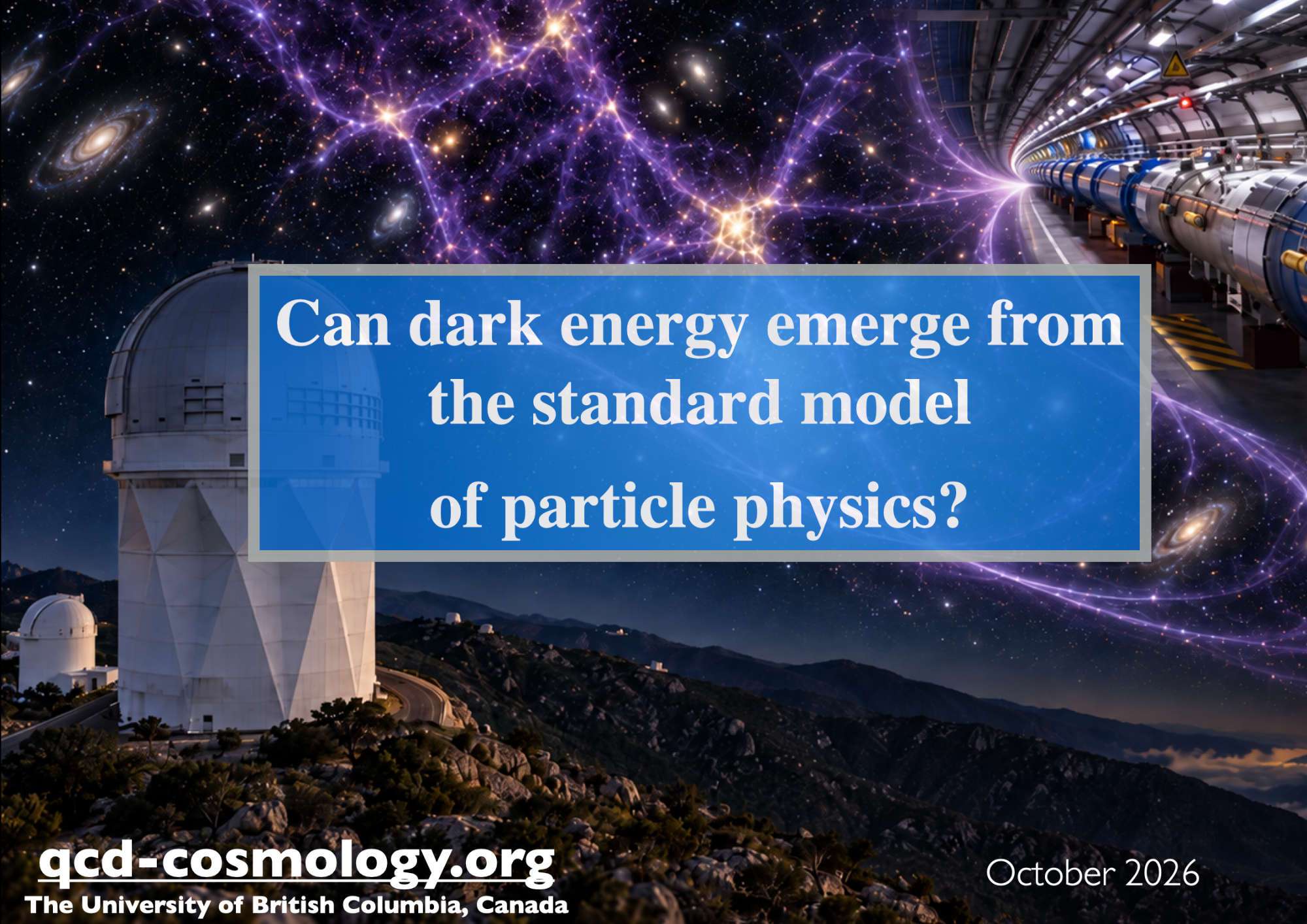
QCD-DE lecture
This lecture will be updated annually to incorporate our team’s latest findings. Follow the link and confirm the download.
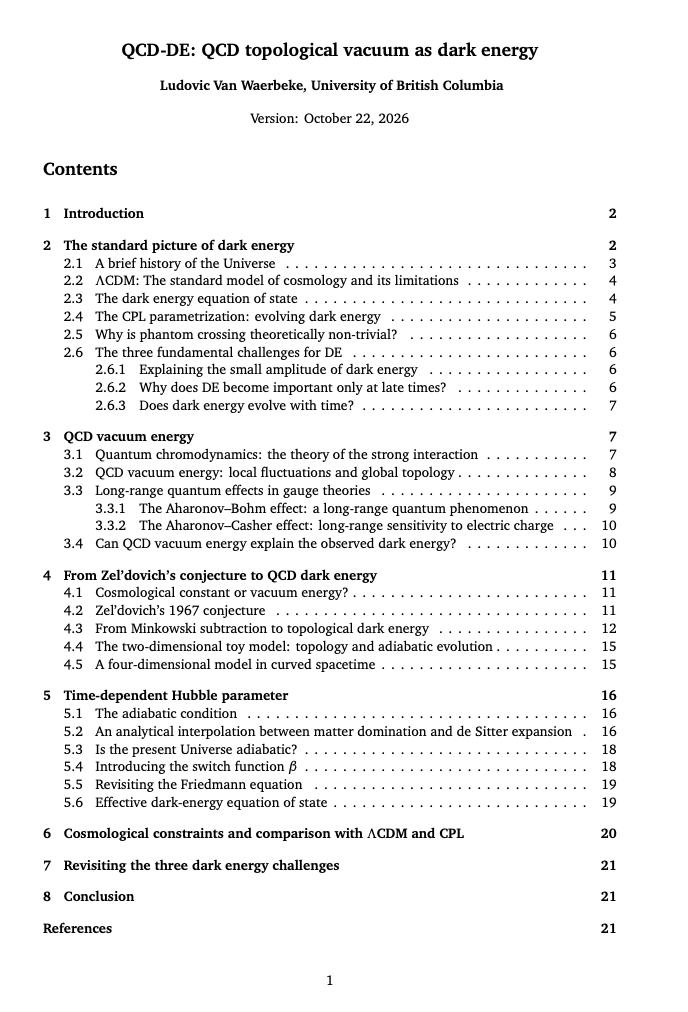
Upcoming observational tests
Upcoming DESI results will measure the Universe’s expansion history more precisely, allowing us to test whether its evolution follows our QCD-DE scenario. Combined with SN Ia and CMB observations, these measurements could strengthen support for the model or rule out its predicted expansion history.
Current projects
Improving the switch function. We are exploring whether a physically motivated relation between the onset and duration of the transition could reduce the activation function to a single free parameter, and therefore increase the Bayesian factor of the QCD-DE model.
Public talks 2026
Colloquia
Observatoire Midi-Pyrénées, Oct 8, 2026
Univ. College London, Oct 21, 2026
Imperial College London, Oct 27, 2026
Univ. of Newcastle, Oct 30, 2026
Univ. of Durham, Nov 5, 2026
Univ. of Bochum, Oct , 2026
Seminars
Oxford, Oct 20, 2026
APC, Nov 12, 2026
Conferences
"DESI results and time dependent Dark Energy from the QCD topological sectors" A. Zhitnitsky. COSMO-26 Conference. Leiden University. August 2026.
Click on the foundational papers
Theory
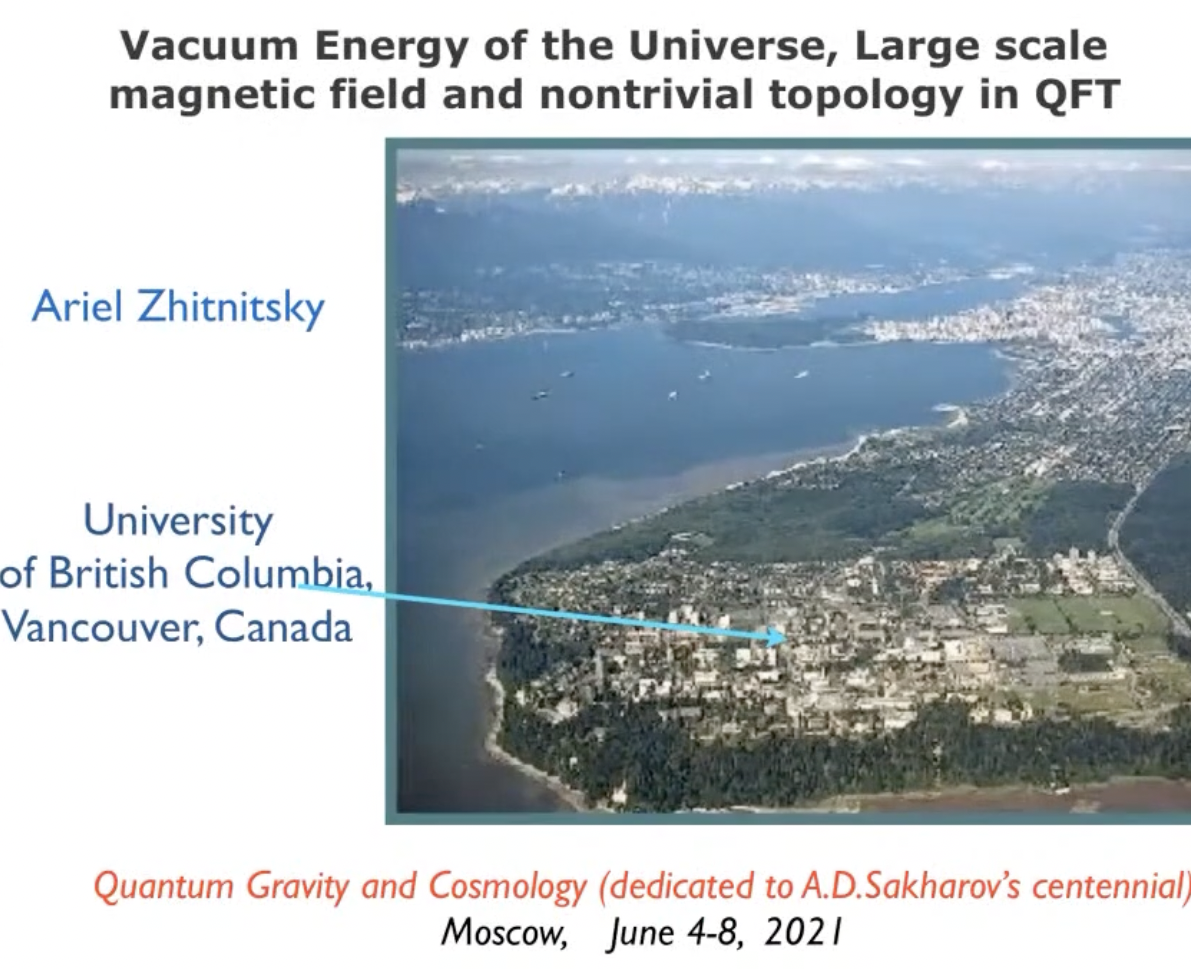
Ariel Zhitnitsky Zoom talk: Vacuum energy of the Universe, large scale magnetic field, and nontrivial topology
Cosmological tests
In the press
PHYS.ORG: Dark energy may originate from known laws of particle physics
Bioengineer.org: Standard Model Nuclear Physics May Explain Dark Energy and Cosmic Expansion
EurekAlert!: Could standard physics explain the mysterious energy driving the Universe apart?
Mirage News: Can Standard Physics Explain Dark Energy's Role in Cosmic Expansion?
ThinkPol: Dark energy may come from the force that holds atoms together, UBC-led study proposes
Universe Space Tech - Dark energy may stem from the known laws of particle physics
IFL Science - Maybe Dark Energy Doesn’t Need New Physics – New Hypothesis Claims It Emerges From Known Particles
The Brighter Side - Dark energy model links cosmic acceleration to the strong nuclear force
Universe Today - Maybe Dark Energy Isn't so Inexplicable After All