QCD and
Dark Energy
What is dark energy ?
For much of the 20th century, astronomers expected gravity to slow the expansion of the Universe. But in 1998, observations of distant exploding stars revealed a surprise: cosmic expansion is accelerating. “Dark energy” is the name we give to whatever causes this acceleration. We do not yet know its physical nature.

This image traces the history of the Universe, from the Big Bang on the left to the present on the right. The widening shape represents the increasing distances between galaxies as the Universe expands; it does not show an actual boundary of space. Following an early burst of expansion called "inflation", the Universe cooled, allowing atoms, stars and galaxies to form. Towards the right, the stronger widening illustrates the recent acceleration associated with dark energy.
What drives this acceleration, and why did it begin so recently in the Universe’s history? The simplest explanation is that empty space itself contains a constant energy density that drives this acceleration. Yet explaining where this energy comes from remains a major challenge.
Our team investigates whether QCD, the theory describing the strong force that binds quarks inside protons and neutrons, could explain dark energy, and how observations could test this idea.
What is vacuum energy ?
In quantum physics, a vacuum is the lowest-energy state of a system, rather than a space where nothing exists. Even without particles, quantum fields remain present and can carry energy. This is called vacuum energy.
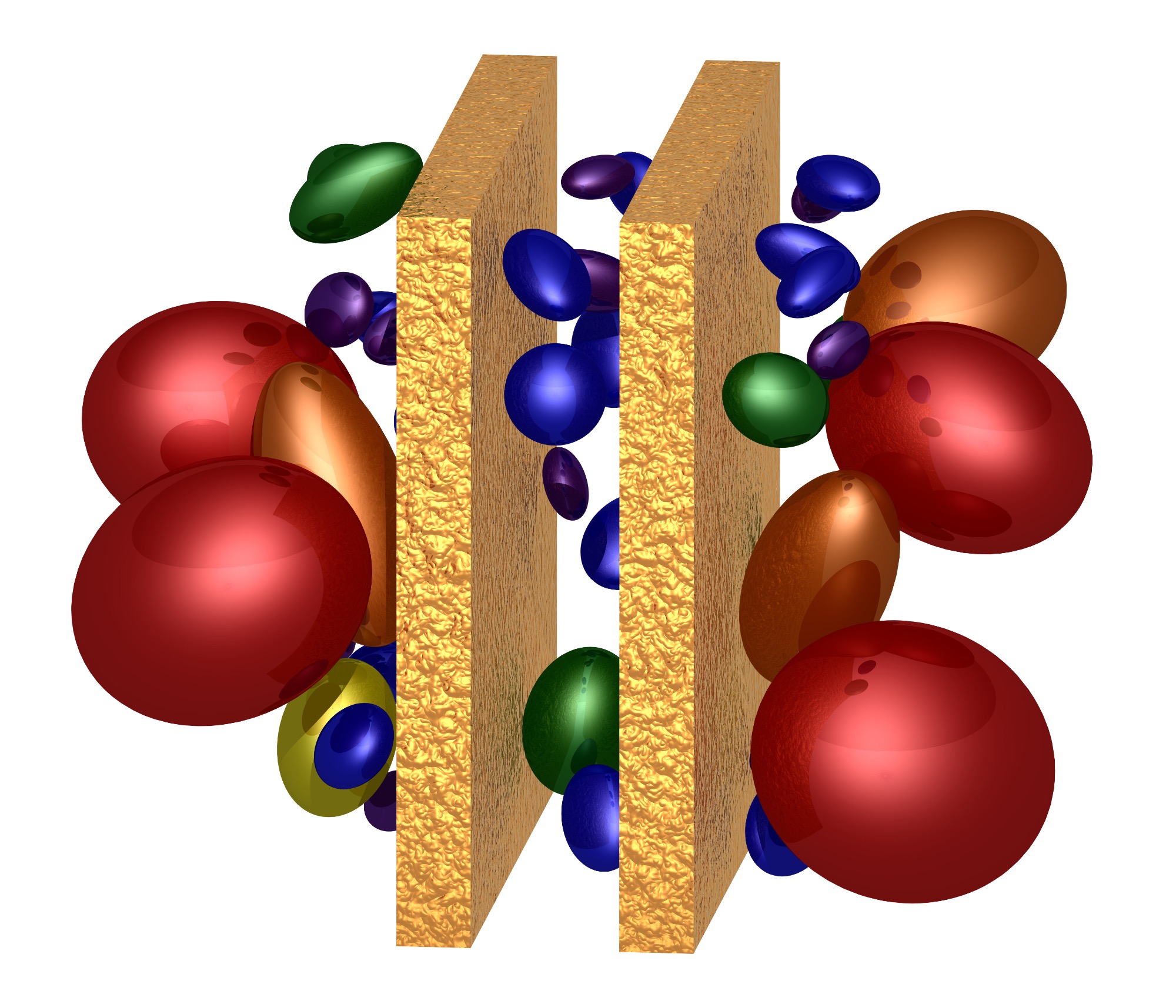
The well established Casimir effect is an example of how quantum fluctuations in the vacuum can give rise to a measurable force between closely spaced surfaces. Quantum fluctuations in the background electromagnetic field produce vacuum energy and Casimir forces on closely spaced parallel plates. Illustration: Greg A L
If that energy affects gravity, it can influence the expansion of the Universe. A constant, positive vacuum energy has the properties needed to produce accelerated expansion, making it a possible explanation for dark energy.
The difficulty is explaining its tiny observed value: straightforward theoretical estimates are vastly larger. Understanding which vacuum contributions gravitate, and why their combined effect is so small, remains a major challenge.

Yakov Zel’dovich, December 1980.
Photo: Woodruff T. Sullivan III / NRAO/AUI Archives, Sullivan Collection. Colour-corrected by Liandrei.
The Zel'dovich conjecture (1967)
Yakov Zel’dovich suggested that cancelling the main vacuum energy contribution could leave a small residual from gravitational interactions between quantum fluctuations.
We propose to revisit this conjecture using the QCD vacuum, obtaining a residual energy of the same order of magnitude as the dark energy inferred from observations.
"Wait... QCD acts over tiny distances. How could it shape the Universe?"
QCD describes the strong interaction, whose familiar effects are confined to distances comparable to the size of an atomic nucleus. Dark energy, by contrast, influences the expansion of the entire Universe. How could physics operating over such tiny distances matter on cosmic scales?

The quark structure of the proton. There are two up quarks in it and one down quark. The strong force is mediated by gluons (wavey). Click for credits.
The key is that the range of a force does not necessarily determine every property of its quantum vacuum. Quantum tunnelling allows transitions between configurations that classical physics would keep separate. Quantum systems can possess global properties even when their ordinary interactions have a short range.

Does dark energy change over time ?
We do not yet know whether dark energy changes with time. In the standard cosmological model, ΛCDM, it is a constant: its energy density remains unchanged as the Universe expands. However, recent observations have raised the possibility that this description may be incomplete.
Short video about DESI, the Dark Energy Spectroscopic Instrument
DESI maps millions of galaxies to reconstruct the Universe’s expansion history. Its measurements, when combined with observations of the cosmic microwave background (CMB) and distant supernovae, favour models in which dark energy evolves. Further DESI measurements and independent observations will determine whether this signal persists.
Independent observations from the Dark Energy Survey (DES) also provide tentative support for dark energy evolving with time.
Furthermore, the disagreement between local and early-Universe estimates of the Hubble constant encourages investigation of dark energy that changes with time.
If dark energy changes with time, this might help explain why its density is so small and why it only began to dominate the Universe relatively recently. But allowing it to change is not enough: we also need a physical explanation for what causes that change.
These findings motivate our team to investigate QCD dark energy, whose proposed connection to cosmic expansion allows its energy density to evolve with time.

Testing the QCD-DE hypothesis
An explanation for dark energy must do more than produce the right amount of energy: it must also describe how the Universe has evolved. The QCD vacuum hypothesis can therefore be tested by translating its underlying physics into predictions that astronomers can compare with measurements.
Several observations provide complementary tests. The cosmic microwave background (CMB) constrains conditions in the early Universe. Distant supernovae trace how cosmic distances have changed. Patterns in the distribution of galaxies provide a cosmic ruler for reconstructing expansion. A successful model must explain these measurements together.
In collaboration with D. H. Lee, C. van de Bruck and E. Di Valentino, we found that QCD dark energy fits cosmological observations as well as other leading dark energy models. When early- and late-Universe observations are combined, the statistical analysis even finds a modest preference for QCD dark energy. More precise measurements, independent analyses and further theoretical development will test whether its apparent advantage persists.
Key takeways
QCD dark energy brings three compelling possibilities together: an energy density of the observed magnitude, a physical explanation for why dark energy became important relatively recently, and a density that can evolve with time. Its competitive fit to cosmological observations makes this a promising avenue to explore.
Remarkably, this framework draws on the established theory of the strong interaction, without introducing any new fundamental field or exotic particle.
This follows the spirit of Occam’s razor: when explanations describe the evidence equally well, we favour those requiring fewer additional assumptions. Much remains to be tested, but the prospect is exciting: the physics behind cosmic acceleration may already lie within a theory we know.
QCD and
Dark Matter

Gravity turns a distant spiral galaxy into a luminous ring, revealing the mass of the galaxy in front—including its invisible dark matter. ESA/Webb, NASA & CSA, G. Mahler. Acknowledgement: M. A. McDonald
What is dark matter?
In 1933, Fritz Zwicky noticed something puzzling in the Coma galaxy cluster: its galaxies were moving so quickly that the gravity of the visible matter seemed insufficient to hold them together. He proposed that unseen matter was supplying the missing gravitational pull.
Decades later, Vera Rubin and Kent Ford uncovered a similar mystery inside spiral galaxies. Stars and gas far from their centres orbited faster than the visible matter could explain. These galaxies appeared to sit within much larger reservoirs of invisible mass.
Today, the clues extend beyond galaxy motions. Dark matter bends light from distant galaxies through gravitational lensing. Its influence also appears in the cosmic microwave background, the ancient light left over from the early Universe. Together, these observations indicate that dark matter outweighs ordinary matter by roughly five to one.
It does not shine like stars or interact strongly with light. Its identity remains unknown.
What we know
about dark matter
from observations
The evidence is everywhere. Galaxies rotate, clusters hold together, and distant light bends around concentrations of mass. Each clue points towards the same conclusion: there is much more matter in the Universe than our telescopes reveal. But what do observations actually tell us about dark matter? Here are the clues.
1.Dark matter outweighs ordinary matter by roughly five to one across the Universe. Yet the balance varies between environments: dwarf galaxies can be far more dominated by dark matter than massive galaxy clusters.
2.We have not detected light that can confidently be attributed to dark matter. That does not mean it must be completely incapable of emitting radiation.
3. Dark matter must have moved slowly enough in the early Universe to preserve the small density fluctuations from which galaxies grew. This is what astronomers mean by “cold.”
4. When galaxy clusters collide, their hot gas collides and slows down, while dark matter appears to pass through largely undisturbed. This could mean its constituents barely interact with one another. Or it could mean they interact but be so rare that encounters are unlikely.
5. The primordial abundances of light elements and the cosmic microwave background impose stringent limits. Any dark matter candidate must avoid disrupting nuclear reactions, the ancient plasma and the growth of cosmic structure.
A multitude of particles with extremely weak interactions is one possibility. A sparse population of massive, compact objects is another. How much they interact with their environment is crucial: rarity alone does not guarantee undetectability.
Over the years, searches that found no confirmed signal have narrowed the list of candidates. Much of the search has focused on abundant elementary particles, such as weakly interacting massive particles (WIMPs), axions or sterile neutrinos, whose interactions with ordinary matter would be difficult to detect.
The observational evidence does not require dark matter to be an elementary particle: rare, dense objects remain another possibility worth investigating.
What motivates
the study of
QCD-AQN?
QCD-AQNs offer an exciting possibility: dark matter could consist of dense aggregates of quarks and antiquarks whose interactions produce observable signals. What motivates this research is that comparisons with observations have yielded encouraging results across remarkably different environments.
On cosmic scales, AQNs would behave as cold, effectively collisionless dark matter. Calculations also indicate that their radiation can remain compatible with measured sky backgrounds and cosmic microwave background constraints.
The most intriguing results concern antimatter nuggets. When ordinary matter encounters their surfaces, annihilation releases energy that can emerge as radiation. Simulations of environments resembling our Galactic neighbourhood predict ultraviolet emission comparable to the unexplained diffuse component observed by GALEX and supported by New Horizons measurements. Independently, estimates of energy deposited in the solar atmosphere reach the scale needed to maintain the Sun’s hot corona.
Other tests bring additional constraints: South Pole Telescope measurements limit their emission, while IceCube searches and Earth’s geothermal heat flow restrict how frequently AQNs can encounter ordinary matter.
Particularly encouraging is that the observational comparisons so far converge on a consistent mass range, broadly a few grams to around two hundred grams. In the framework used for these calculations, the average AQN mass is the only freely adjustable parameter, making this agreement across different environments a consistency test.
This provides a strong incentive to sharpen the calculations and pursue decisive tests, especially searches for the predicted “dark glow”, a faint emission released when rare antiquark aggregates collide with ordinary protons.
QCD-AQN
in the early
universe
SORRY... UNDER CONSTRUCTION
QCD-AQN
and QCD-axions
SORRY... UNDER CONSTRUCTION